Titlipur panchayat
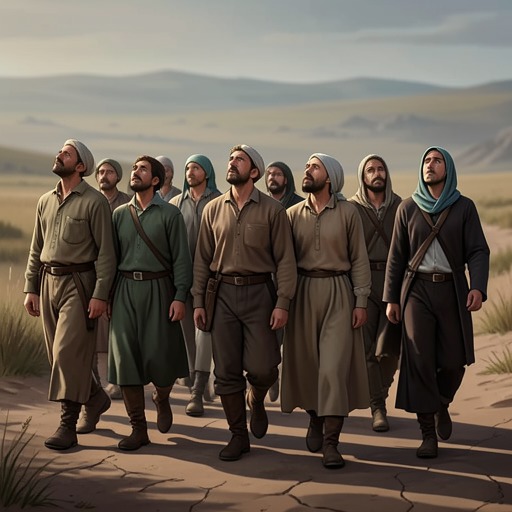
The Satanic VersesThe Titlipur panchayat is the village council whose decisive act is to authorize the community’s response to Ayesha’s command: every villager is to walk toward Mecca, trusting that the sea will open at the journey’s end. The council’s deliberation takes place in the village’s great banyan, a setting where civic life and the natural world are intertwined. Its unanimous decision organizes a practical departure, but it also commits the villagers to a perilous passage whose consequences extend far beyond the meeting branch.
Setting and Structure
The council assembles on the mightiest branch of the immense banyan that shelters Titlipur. The tree’s roots cover more than half a mile, and the village has grown so intricately through and around it that the two are difficult to distinguish. Branches serve as pathways, some shelters occupy the foliage, and the council’s meeting place is itself part of this shared, living structure. The villagers call the tree by the village’s name and the village simply the tree; even the banyan’s animal inhabitants are treated as fellow citizens. The panchayat is thus situated not in a separate civic building but within the habitat that organizes everyday communal life.
At the emergency meeting called after Ayesha returns, the council members take their familiar places on the branch while she stands below them. The gathering is described as a quintet, and the Sarpanch, Muhammad Din, acts as its leading voice. Its authority appears local and deliberative: the council considers the community’s crops, homes, and capacity to travel together, and its decision must be carried out by households with very different needs. The meeting’s familiar setting gives this extraordinary decision a place within the ordinary institutions of the village.
The Emergency Meeting
Ayesha tells the council that Gibreel has brought a message that is also a command: the whole village, men, women, and children, must prepare to walk to Mecca. Muhammad Din initially resists. He points out that leaving the village en masse is unthinkable and that poverty or ill health can excuse people from pilgrimage. The other elders argue over the crops and the practical impossibility of abandoning their homes. The council’s first response is therefore not immediate obedience but a debate about obligation, livelihood, and the limits of what the community can undertake.
The debate ends without a recorded resolution or spoken agreement. Ayesha remains silent, and the narrative describes that silence as spreading through the group; for a long interval, the question is settled without anyone explaining how. Osman, the convert, is the first to speak again. He asks how the village can make a journey of almost two hundred miles to the sea when it includes old people and babies. Ayesha answers that the pilgrims will reach the shore on foot and then cross the sea floor to Mecca. The council’s transition from argument to commitment is thus marked less by a formal vote spoken aloud than by a collective pause whose meaning becomes visible in what follows.
From Decision to Departure
By the next morning, the panchayat has voted unanimously to obey the command, and preparations are underway beneath the banyan. Muhammad Din first considers having a carpenter build ox-drawn litters for the old and infirm. His wife rejects that accommodation on the ground that the angel’s instruction requires walking. The plan exempts only the youngest infants, who are to be carried in rotation on the adults’ backs. That arrangement shows the decision being translated into shared duties rather than left as a declaration of belief.
The villagers pool their resources. Potatoes, lentils, rice, gourds, chillies, aubergines, cooking utensils, and bedding gather beside the council’s branch; provisions are to be divided evenly among the walkers. They will take beasts of burden and a few carts, including carts for live chickens, while keeping personal belongings to a minimum. The preparations begin before dawn and are well advanced when Mirza Saeed Akhtar arrives. He slows the work with forty-five minutes of angry speeches and by shaking villagers by the shoulders, but eventually leaves, and the preparations resume at their earlier pace. His protest does not reverse the council’s decision or prevent departure.
Consequences and Narrative Significance
The council’s authorization becomes the basis for a long collective march, but the institution is not shown directing every later stage. The pilgrims advance slowly, walking in the morning and again after the heat, at the pace of the slowest among them. Illness, official harassment, and practical delays limit them to about two miles a day at best; the journey takes approximately eleven weeks to reach the sea. Khadija dies during the march, on its eighteenth day. Her death makes concrete the human cost of the obligation the council accepted, while the continuing journey shows the decision’s hold even as the group encounters loss and hardship.
By the ninth week, the story of the village walking to the sea has attracted journalists, politicians, commercial sponsors, tourists, and others seeking to interpret or exploit the procession. Religious extremist groups denounce the pilgrimage as a provocation and dispute its place within public religious and national life. At the sea, the pilgrims walk into the water and disappear; several people who enter after them are rescued, and the pilgrimage ends. The panchayat’s unanimous decision has carried the village from a debate beneath its banyan into a journey watched and contested across the country. The contrast between the council’s concrete preparations and the extraordinary outcome keeps its role sharply defined: it can deliberate, organize, and bind the community to a course of action, but it cannot settle what the journey means or control what follows.